 Coingecko
 helps you compare trading pairs before choosing an exchange
Coingecko shows individual trading markets so you can compare an asset’s price, reported volume and liquidity before choosing an exchange. Start with the exact pair you need, then examine its spread, depth and update status together. A market with an attractive displayed price may require another conversion or offer little liquidity for your order. Your shortlist remains provisional until the destination confirms the same asset, usable market and applicable costs.
A market comparison becomes actionable when the exact pair, available liquidity and destination quote support the trade you intend to make.
Order books and liquidity pools produce different trading quotes
An order book matches buyers with sellers, while an automated market maker uses liquidity pools and a pricing formula. That difference affects how you interpret a market listing. For an order book, the available bids and asks show buying and selling interest at specific prices. For a pool, the swap quote depends on its liquidity and the amount being exchanged. A displayed token price does not describe every possible trade size.
Compare markets that support the task you actually intend to complete. Buying an asset directly with your available quote asset differs from first converting into another asset. The extra conversion introduces another price, fee and execution step. A pool route also requires compatible assets on the relevant network. These differences belong in the comparison before a small price advantage determines your choice.
The exact pair determines what you must spend or receive
A trading pair identifies the asset being traded and the quote asset that expresses its price. Buying the base asset generally spends the quote asset; selling it receives the quote asset. A common display currency can make prices easier to compare, without changing the assets that the underlying market trades. Keep those two layers separate when reading a converted price beside a pair label.
Asset identity also matters at the destination. A shared ticker does not establish that two tokens have the same contract or network. For tokens, the applicable network and contract distinguish the asset more precisely than its abbreviation. An exchange listing and a compatible deposit route answer different questions: a market can exist without accepting the particular token representation you hold.
Spread and depth explain different parts of execution cost
The spread measures the gap between the best available buying and selling prices in an order book. A tighter spread reduces that immediate gap, all else equal. It says little about how much can trade at those prices, however. The best offer may cover only a small part of an order.
Depth describes the liquidity available across a price range. The +2% and -2% depth metrics describe the capital required to move the market price by 2% in the respective direction. These are defined measurement bands, not promised limits on a trade’s price movement. The values change as orders and liquidity change.
A narrow spread can coexist with shallow depth. An order that consumes nearby liquidity can reach less favorable prices.
Buying and selling use opposite sides of the book, so their available depth can differ. Compare the side relevant to your intended trade and inspect the destination’s quote for your actual amount. Pool swaps require a corresponding check of quoted output and price impact. Neither a depth reading nor a spread figure includes every fee that a venue may charge.
Does the highest reported volume identify the best market?
The highest reported volume does not establish that a market offers the best execution for your intended trade. Volume describes trading activity over a period; depth describes available liquidity around the market price. A busy market can therefore offer a different execution outcome from the one its volume rank suggests.
Individual trading-pair assessments consider liquidity, trading volume, order book depth and trading activity. An exchange-wide Trust Score has a broader scope than the particular pair you need. Use the pair’s own market conditions when comparing execution, with the exchange assessment providing additional context. A strong exchange-wide assessment does not establish your eligibility to use that venue or the availability of its deposit routes.
Update status changes the meaning of a price difference
A price difference deserves less weight when the underlying market observation is stale or flagged as anomalous. Trading-pair records include update information and flags that distinguish these conditions. Stale data describes an older observation; an anomaly flag identifies data that requires caution. Neither condition proves that the displayed price remains available for an order.
Missing information is a separate limitation. An empty depth field does not mean unlimited liquidity, and an unavailable spread does not mean a zero spread. Keep the missing measurement unresolved until the destination provides enough information for the comparison. A screenshot preserves the observation you saw, including any timestamp visible in the capture, rather than reserving the quoted market conditions.
Funding and withdrawal requirements can outweigh a price advantage
The relevant cost depends on the transfers and conversions needed to reach the market and use the resulting asset. Trading fees belong alongside the spread and potential price impact. Funding charges, network costs and withdrawal fees matter when those actions form part of your intended route. Their amounts can vary by asset, network, venue and account conditions.
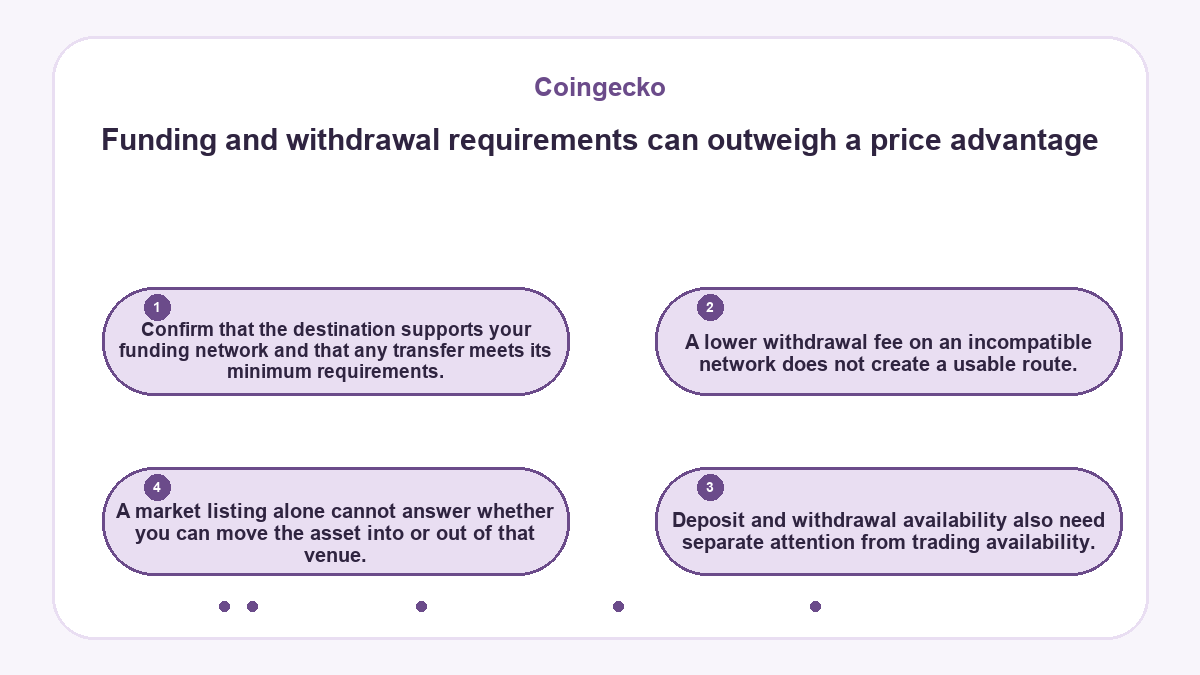
Confirm that the destination supports your funding network and that any transfer meets its minimum requirements. A lower withdrawal fee on an incompatible network does not create a usable route. Deposit and withdrawal availability also need separate attention from trading availability. A market listing alone cannot answer whether you can move the asset into or out of that venue.
The destination must offer the expected pair and a usable quote
Consider a hypothetical comparison between two order-book markets for the same asset and quote asset. All market conditions in this example are hypothetical. One market shows a lower price with an older update; the other shows a slightly higher price with a recent update. Both are candidates, provided the destination can confirm the exact pair and a usable quote before any commitment.
The reader selects the recently updated market for closer inspection. The destination displays the expected pair and an order preview whose costs and available quantity meet the reader’s requirements. That confirms a usable candidate. The comparison ends with an inspected trade preview; no order has been submitted and no funds have moved.
If that destination instead reports the pair as unavailable for trading, the reader cannot place the intended order despite expecting an active market. The reader leaves without submitting or funding anything and returns to the shortlist. The older listing remains unconfirmed until its own destination supplies a usable market and fresh quote.
Opening an exchange preserves your choice until you authorize an action
Following a market listing takes the comparison to the trading venue; submitting an order or transfer is a separate action. Coingecko provides trading information, while buying and selling take place through exchanges. Simply inspecting another market leaves the earlier shortlist available for comparison.
After an order is submitted, closing the browser does not cancel it. Cancellation depends on the venue’s rules and the order’s remaining open quantity. A completed fill remains a completed trade; cancelling an unfilled remainder does not reverse it. The venue’s order status and execution records establish what happened. A market screenshot or portfolio valuation cannot replace those records.
Going straight to an exchange you already use avoids comparing unfamiliar funding arrangements. Comparing several markets adds value when their available pairs, liquidity or total costs differ materially. Either approach reaches the same final requirement: the destination must support the intended trade on terms you can inspect before authorizing it.
Coingecko FAQ
Can a limit order keep my purchase within a chosen price?
A buy limit order sets the highest execution price you accept, although fees remain separate. It can execute at that price or lower when matching liquidity is available. It may also remain unfilled or fill only partly. A price displayed in a market comparison does not guarantee that sufficient sellers will accept your limit at the destination.
What minimum amount do I need for a listed trading pair?
The destination venue determines the minimum order amount for the specific market. A market-data listing does not establish that your intended amount meets its trading requirements. Deposit minimums can also differ from order minimums, so having enough for a trade does not automatically make a smaller funding transfer usable. Check the applicable requirements before sending funds.
How should I interpret a market that disappears from the list?
A missing listing establishes that the market is absent from the displayed results, not necessarily that the exchange has stopped trading it. Data filtering and removal can affect market visibility. The destination’s market status is needed to distinguish an unavailable trading pair from an absent data record. A previously saved listing cannot establish continuing availability.
Is a blank trading-pair Trust Score the same as a poor score?
A blank or unavailable trading-pair Trust Score is not equivalent to an explicitly poor rating. It leaves that assessment unavailable for the comparison. Evaluate the remaining pair information without treating the missing score as either approval or rejection. For API ticker data, the trust_score field was deprecated effective March 3, 2026 and now returns null across affected endpoints; that null value does not indicate a poor rating.
Do withdrawal minimums matter when I only plan to buy?
Withdrawal minimums matter if your intended outcome includes moving the purchased asset out of the exchange. A completed purchase may leave a balance below the destination’s withdrawal requirement, especially after fees. If you intend to retain the asset there, withdrawal is a separate future action with its own conditions. Compare those conditions before choosing a market when external delivery is part of your task.