 Coingecko
CoinGecko portfolio: Accurate inputs for tracking gains
CoinGecko portfolio tracks holdings and performance using recorded transactions or supported public wallet data. Accurate quantities establish the position being valued, while purchase prices explain its cost. In a manual portfolio, adding a coin to a watchlist alone does not establish your investment history. Meaningful gains and losses require records that describe the activity behind your holdings.
A balance, a purchase record and a market price answer different questions. Comparing these inputs helps explain an unexpected total without confusing a tracking entry with an actual trade or treating every change in value as investment performance.
Manual records, wallet tracking and watchlists
Manual portfolios use the transactions you enter, while wallet tracking reads publicly available activity for a supported address. A watchlist follows selected coins without requiring a record of ownership. These options differ primarily in where their information comes from: your entries, supported blockchain data or your selection of assets to follow.
Wallet tracking includes holdings, portfolio value and performance metrics for supported tokens. Network coverage and token support constrain what appears. Manual records allow you to represent purchases using details from your transaction history. Neither method turns the portfolio into custody: recording a purchase does not buy crypto, and a displayed holding does not create a withdrawable balance inside CoinGecko.
Record quantities and execution prices separately
A manual purchase needs an asset quantity and a price per unit that describe the same transaction. Entering the total amount spent as the unit price overstates the purchase cost whenever the quantity exceeds one unit. Decimal placement matters just as much: an incorrect quantity changes both the tracked holding and its calculated value.
The relevant price is the execution price recorded for your purchase. A market chart describes market activity over time; it does not reproduce your individual order. Likewise, the price displayed while entering an older purchase need not equal its historical execution price. Preserve the transaction date and distinguish the amount paid for the asset from any separately charged fee. Where an entry includes a fee field, check its stated currency and avoid counting a fee twice.
Keep the underlying purchase confirmation. A plausible portfolio total cannot establish that the quantity, date and cost were entered correctly.
Purchases, sales and movements between accounts
A purchase increases the acquired quantity, while a sale reduces the quantity held and records disposal proceeds. Moving existing assets between accounts that you own is a different event: the movement itself creates neither a fresh purchase nor sale proceeds. A tracker covering all those accounts should not treat the same assets as newly acquired each time they move. Transfer fees can still reduce the amount remaining. The appropriate record therefore depends on whether the portfolio represents one account or the combined holdings across your accounts.
Why does Total Cost stay unchanged after a sale?
Total Cost stays unchanged after a sale because it records purchase spending rather than the net amount remaining invested. That behavior alone does not establish an error in the sale entry or the portfolio calculation.
Inspect the quantity held and the recorded sale separately from that cumulative cost figure. Changing a correct purchase merely to make Total Cost fall would distort the historical record. The distinction becomes especially relevant after partial sales, when purchase spending remains visible alongside a smaller holding. Total Cost and the current holding value describe different things, so their difference alone need not describe performance across a history containing sales.
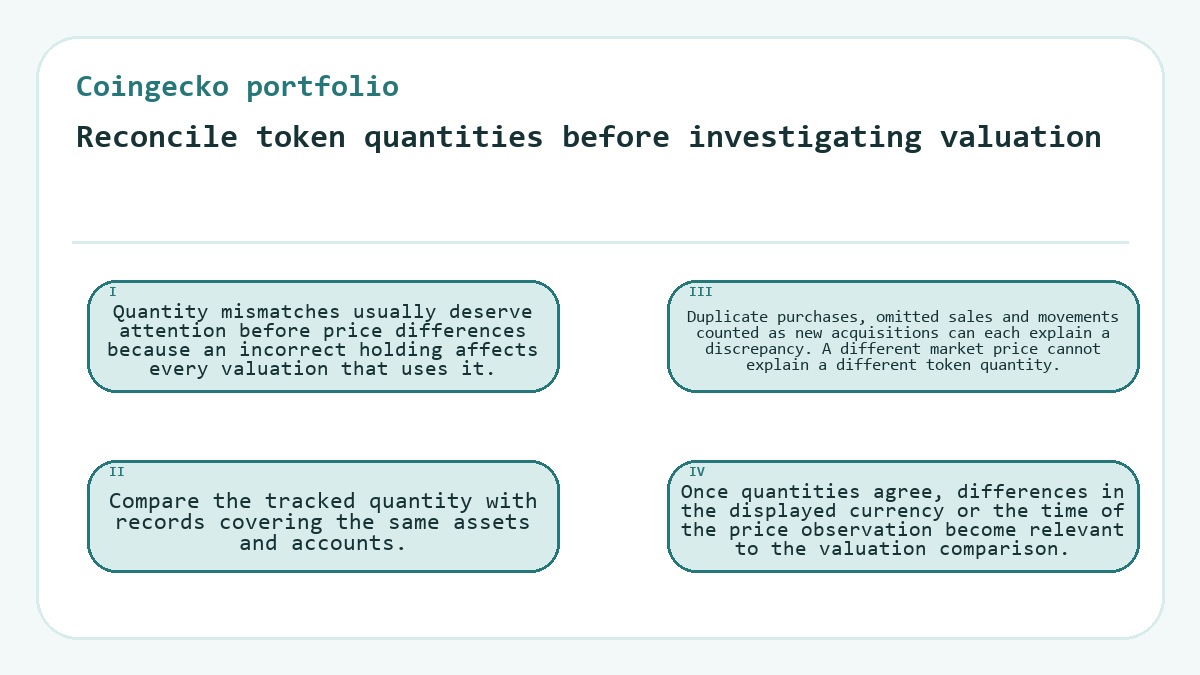
Reconcile token quantities before investigating valuation
Quantity mismatches usually deserve attention before price differences because an incorrect holding affects every valuation that uses it. Compare the tracked quantity with records covering the same assets and accounts. Duplicate purchases, omitted sales and movements counted as new acquisitions can each explain a discrepancy. A different market price cannot explain a different token quantity. Once quantities agree, differences in the displayed currency or the time of the price observation become relevant to the valuation comparison.
Check a purchase before saving it
Consider a hypothetical purchase in a manual portfolio with no existing records for the selected coin. All quantities and prices in this example are hypothetical: the purchase is 7.6 units at 13.85 currency units each. There are no fees, sales or transfers. The purchase confirmation therefore supports a cost of 7.6 × 13.85 = 105.26 currency units.
Before submission, compare the entered quantity and unit price with that confirmation. If the draft quantity reads 76, canceling the entry leaves the saved holding unchanged and avoids recording a purchase ten times too large. Saving the corrected quantity of 7.6 records the intended purchase. This choice applies to a manual transaction form, rather than an automatically tracked wallet record.
After saving, the transaction history should show 7.6 units at 13.85 each. At a hypothetical reference price of 15.35, the holding value is 7.6 × 15.35 = 116.66 currency units. The increase over purchase cost is 11.40 currency units before any sale costs. The recorded quantity and purchase history confirm the entry; the changing market value does not. A different reference price changes that valuation without changing what the purchase originally cost.
Does a larger portfolio value mean a trading gain?
A larger portfolio value does not necessarily mean a trading gain because additional purchases also increase the holdings being valued. Performance comparisons need to separate money added from changes in asset prices. Selling assets can reduce the displayed holding value even when the sale realizes a profit. Conversely, an unrealized gain describes appreciation in assets still held. The amount ultimately received from selling them depends on the execution price and applicable costs, rather than the portfolio valuation alone.
Average net cost and remaining holdings
Average Net Cost connects the net cost figure with the quantity still held in the manual tracker. Multiplying Average Net Cost by Holdings gives Net Cost. Use these named fields together rather than substituting Total Cost, which retains the purchase-spending meaning described earlier. The distinction helps explain why two cost figures can differ without either field being broken.
An average is also a summary. It does not preserve the details of every purchase or explain every movement between accounts. Missing transactions can therefore leave an apparently reasonable average alongside an incomplete history. Retaining the individual records makes it possible to understand the number rather than treating a displayed average as proof that the history is complete.
Preserve transaction details before removing a coin
Removing a coin changes the portfolio’s tracking record; it does not sell the underlying asset or reverse a trade. The Remove coin option is therefore different from recording an actual sale. A sale belongs in the transaction history when a disposal happened. Removal concerns which coin remains in the selected portfolio.
Preserve purchase confirmations and other transaction details before removing records that you may need to reconstruct. CoinGecko’s website and mobile app do not provide a download or export of manually created portfolio transactions. Keeping a separate record is particularly useful when investigating an incorrect total or moving your tracking elsewhere. A screenshot of the overall balance captures a valuation, but it does not necessarily preserve the transactions that produced it.
Recreating a coin entry should not be treated as a promise that earlier records will return. Recovery depends on retaining the information needed to rebuild the history.
Common questions about Coingecko portfolio
Can someone viewing my shared portfolio see my purchase amounts?
Shared portfolio watchlists hide Holdings and P&L by default. Sharing the list is therefore different from publishing the transaction information used to calculate your performance. The public list still reveals which coins it contains, so consider that visibility separately from the privacy of purchase amounts and holdings.
Do I need to sign a wallet transaction to track an address?
CoinGecko wallet tracking uses a public wallet address without requiring wallet permissions, approvals or signatures. It reads publicly available blockchain data for supported holdings. A request to authorize spending is not part of that tracking operation, and entering an address does not give the tracker authority to move its assets.
Is a missing wallet performance figure the same as zero profit?
A missing performance figure does not establish zero profit. Wallet tracking provides P&L and average buy price for supported tokens, so the availability of a holding does not by itself establish that every performance metric is available. Treat an absent figure as missing information rather than inserting zero into your own calculations.
How should I record an order that filled at several prices?
Use the actual filled quantities and their corresponding execution prices. If you consolidate the fills into a purchase record, calculate the weighted unit price by dividing their combined purchase value by their combined quantity. Equal fill quantities guarantee that a simple average of the prices matches the weighted unit price; unequal quantities can produce a different result. Keep fee amounts separate from that calculation unless they are deliberately included in the recorded cost.
Will my portfolio be available on both the website and mobile app?
CoinGecko supports portfolio synchronization across devices through your account. Use the same account when comparing the website and mobile app, and select the same portfolio. Matching saved transactions provides a clearer comparison than matching displayed valuations, because market prices can change between the times that you view each device.
What information should I retain when a purchase used another cryptocurrency?
Retain the quantity surrendered, the quantity received, the transaction time and any fee details. Both assets changed, even though no fiat payment occurred. A cost expressed in a chosen display currency also needs a consistent valuation basis for that transaction. Keeping the original amounts preserves information that a single converted purchase price cannot fully describe.